
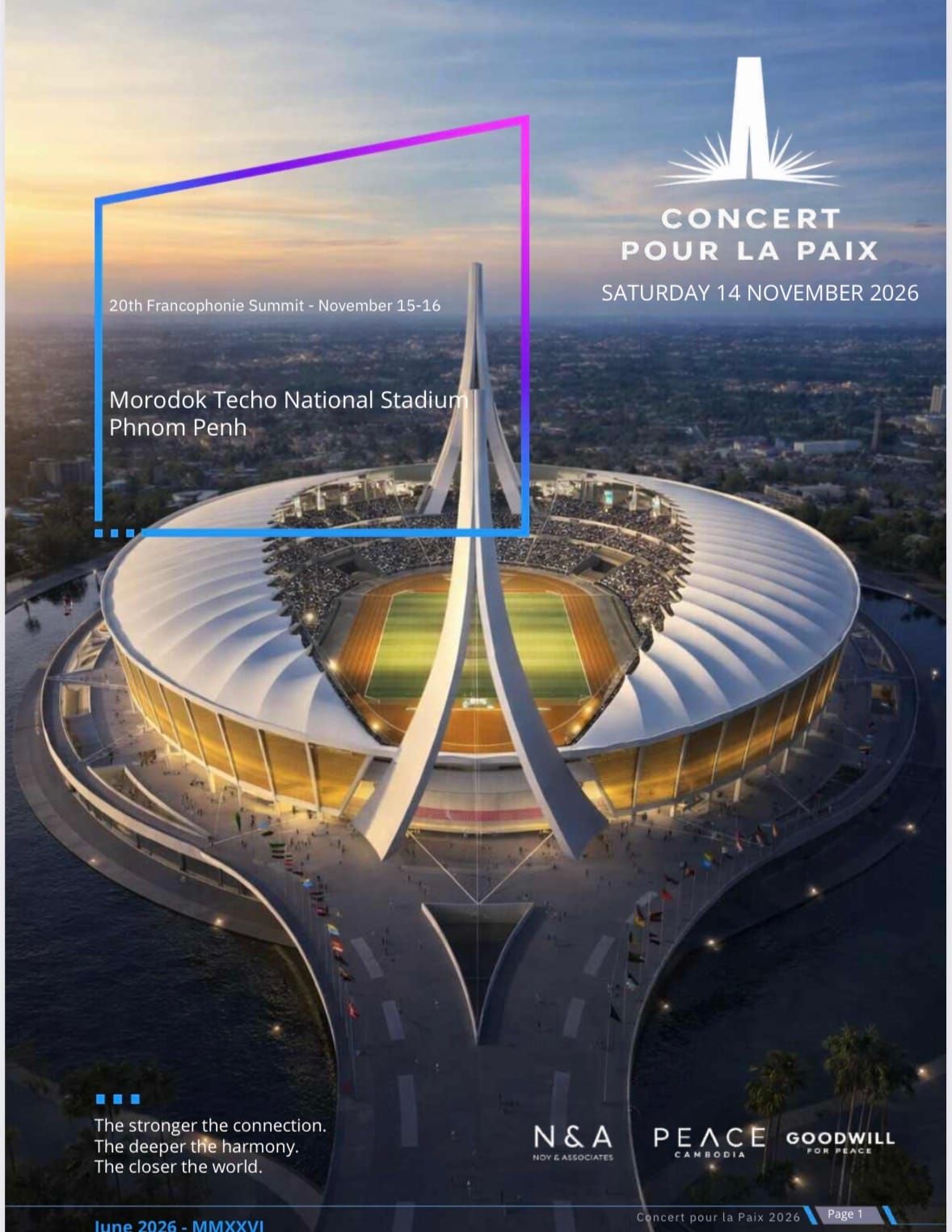
Announced in Phnom Penh from 12 to 14 November 2026, just days before the Francophonie Summit, the “Three Days for Peace” project promised three days of sport, international dialogue and music. But a statement issued by the management of Morodok Techo Stadium, one of the announced venues, has raised questions about the authorizations obtained and the information communicated to the public.
On 9 October 2026, Cambodia’s National Sports Complex (NSC), which manages Morodok Techo Stadium, published a statement on Facebook saying that it had granted no authorization to Goodwill for Peace to organize the announced activities at the venue from 12 to 14 November 2026.
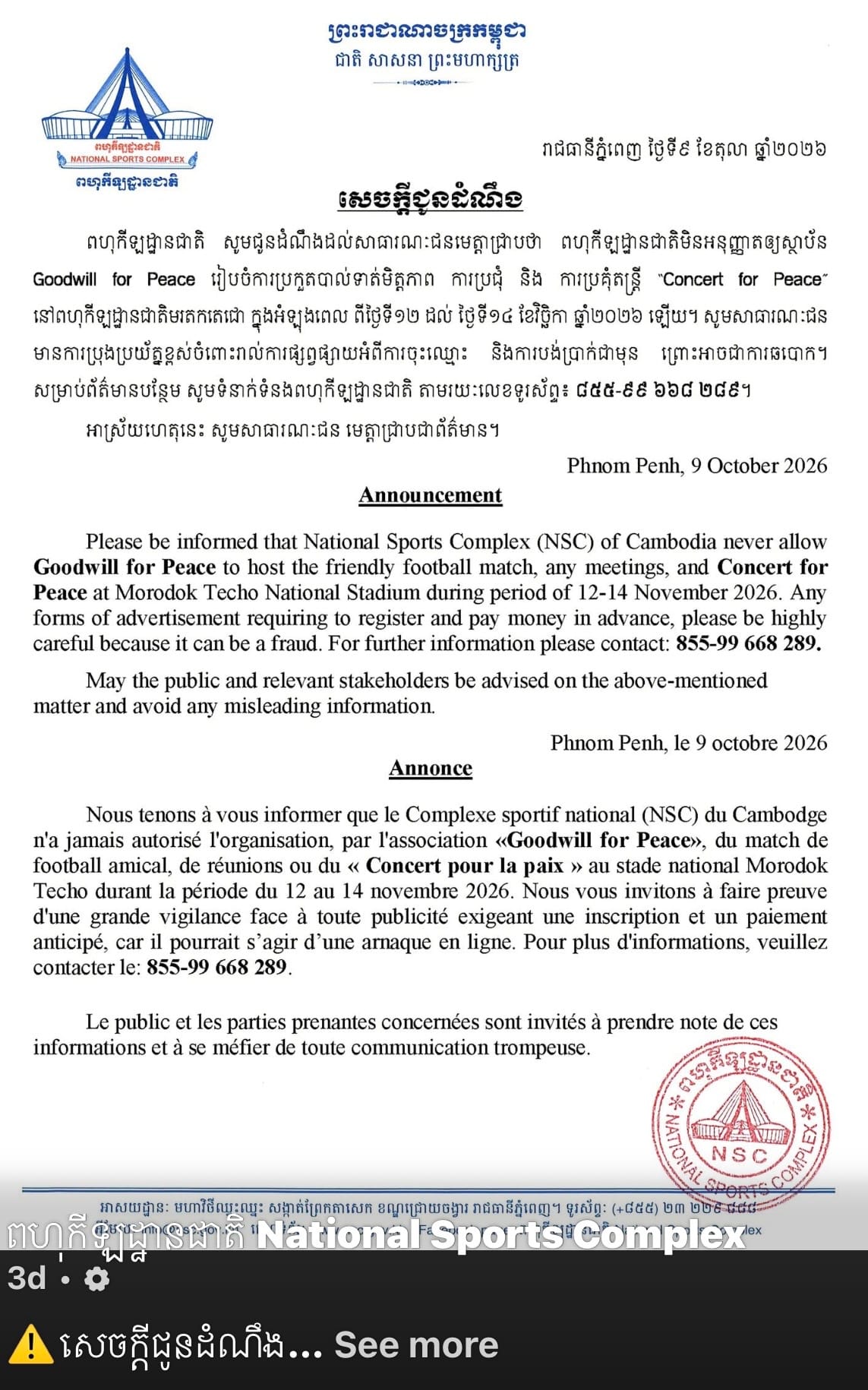
In the same post, the NSC urged the public to remain vigilant regarding announcements requesting registrations or advance payments, warning that they could present a risk of fraud.
This statement alone is not sufficient to conclude that fraud has occurred, nor does it determine the status of activities planned at other venues. It nevertheless raises questions about the preparation of the “Three Days for Peace” project, whose ambitions extended far beyond those of a simple concert.
Promotional documents reviewed by Riel Media referred in particular to the potential participation of international artists including David Guetta, Aya Nakamura, Shakira, Stromae and Jason Derulo.
Among the public figures cited as references for the international meetings were also Barack Obama, Malala Yousafzai, Muhammad Yunus, Nadia Murad and Denis Mukwege, all Nobel Peace Prize laureates.
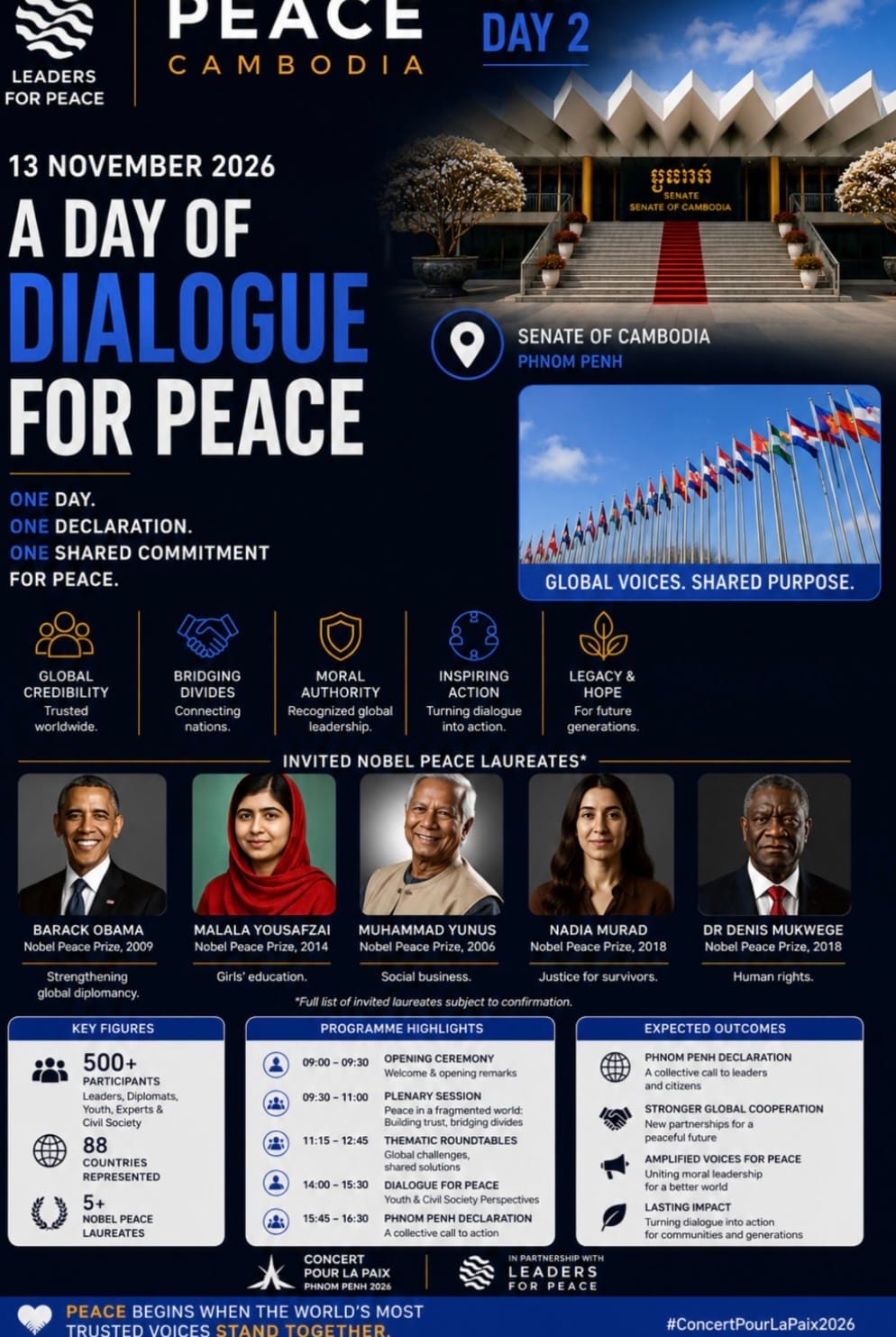
The documents presented these names as individuals being considered, invited, or awaiting confirmation, rather than as a confirmed list of participants.
The scale of such a programme nevertheless raises an essential question: how can these ambitions be turned into concrete commitments?
Bringing together world-renowned artists and international figures requires substantial financial resources, complex logistical arrangements and, in some cases, specific security measures. The schedules of high-profile figures such as Barack Obama generally need to be arranged well in advance.
According to testimonies collected by Riel Media from individuals who were approached to provide financial support for the project, the organizers were still seeking funding less than six months before the announced event.
These testimonies do not, however, make it possible to establish the total amount of funding already secured, nor how much remained to be raised.
Seeking sponsors is a normal part of organizing major events. It nevertheless raises questions about the timeline required to confirm an international programme of this scale.
It is precisely in this context that organizers and those directly involved in the project need to critically assess their own ambitions. Beyond the desire to make an initiative succeed, it is essential to evaluate its feasibility by comparing the objectives announced with the funding available, the time remaining, and the commitments actually secured.
Travel offers raising further questions
Adding to these concerns are questions surrounding the travel packages associated with the event.
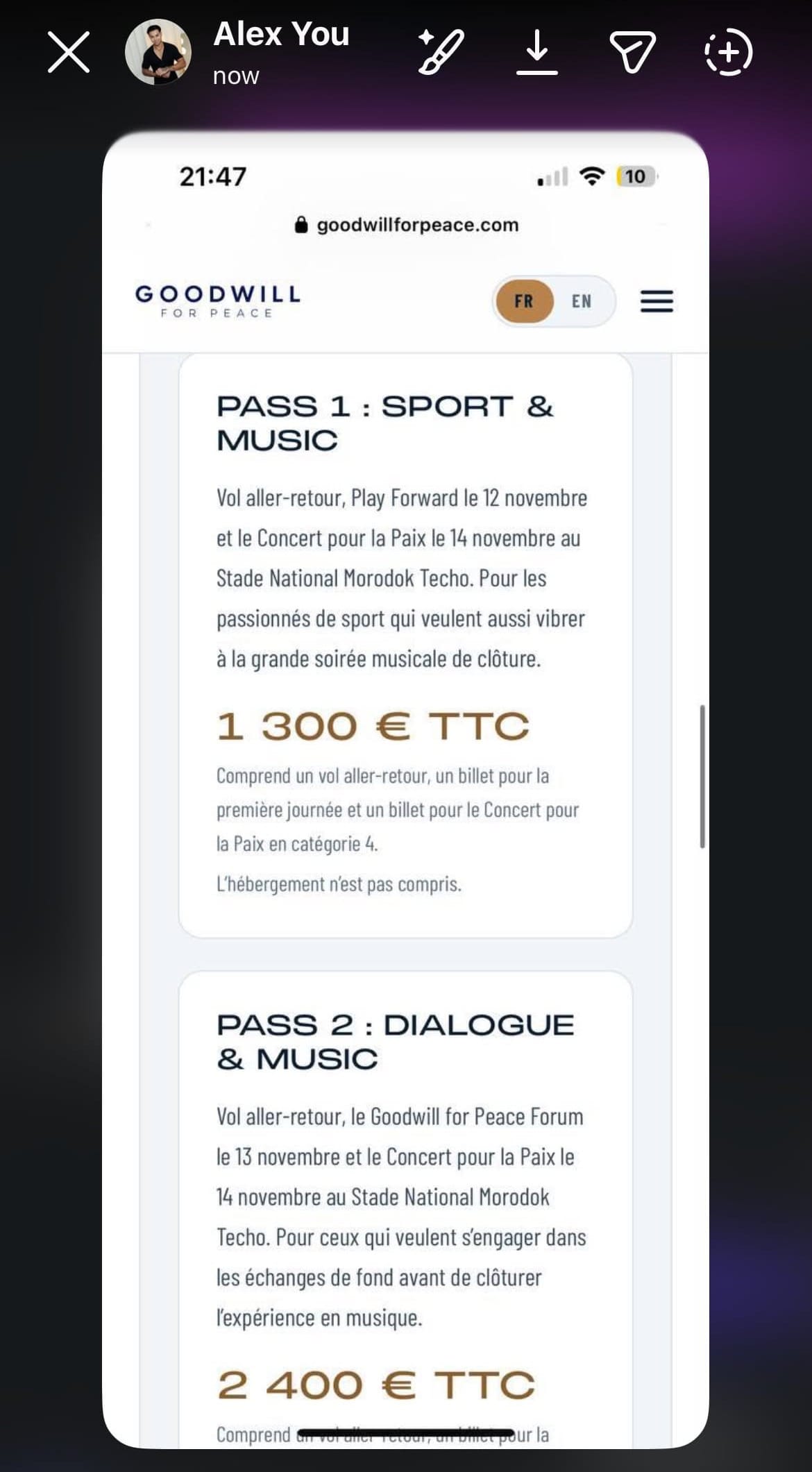
Posts shared on social media advertised packages starting at €1,300, including round-trip transportation and access to the announced activities, but excluding accommodation.
Travel offers raising further questions
These proposals were linked to the promotion of the project. However, the information currently available does not make it possible to determine whether they amounted to preliminary registrations, confirmed bookings, or services that were actually being sold.
Riel Media has also been unable to establish whether any participants made payments.
Under these circumstances, one question remains: what guarantees were communicated to people interested in these offers, while the operator of one of the main announced venues states that no authorization had been granted?
The NSC statement is not sufficient to establish fraudulent intent. It does, however, justify calls for the organizers to clarify the status of the authorizations, bookings and commitments made to the public.
When visibility strengthens a project’s credibility
Beyond the artists and public figures being considered, “Three Days for Peace” also received exposure on social media, particularly within the Francophone community.
These endorsements and mentions may have increased the event’s visibility and given it additional credibility in the eyes of the public.
When a project is promoted by people known for their experience or professional networks, it can naturally inspire confidence. But that trust does not replace the need to verify the information being communicated.
Someone may promote an initiative in good faith without necessarily knowing the exact status of its authorizations, funding or contractual commitments.
This situation also highlights the importance, for the public, of distinguishing promotional announcements from official confirmations.
When an event claims the support of a recognized institution, it is advisable to seek confirmation directly through that institution’s official channels, including its website or official social media accounts.
Questions that remain unanswered
Several questions remain regarding the organization of “Three Days for Peace.”
What steps had been taken with the management of Morodok Techo Stadium? Had an agreement been requested, or was one still under negotiation? What authorizations had been obtained for the other announced venues?
How much funding had actually been secured when the promotional materials were circulated? What was the exact status of the travel offers and any potential bookings?
Riel Media contacted two individuals presented as the project’s founder and co-director to seek clarification on these points and to give them an opportunity to provide their version of events.
At the time of publication, neither had responded to these requests.
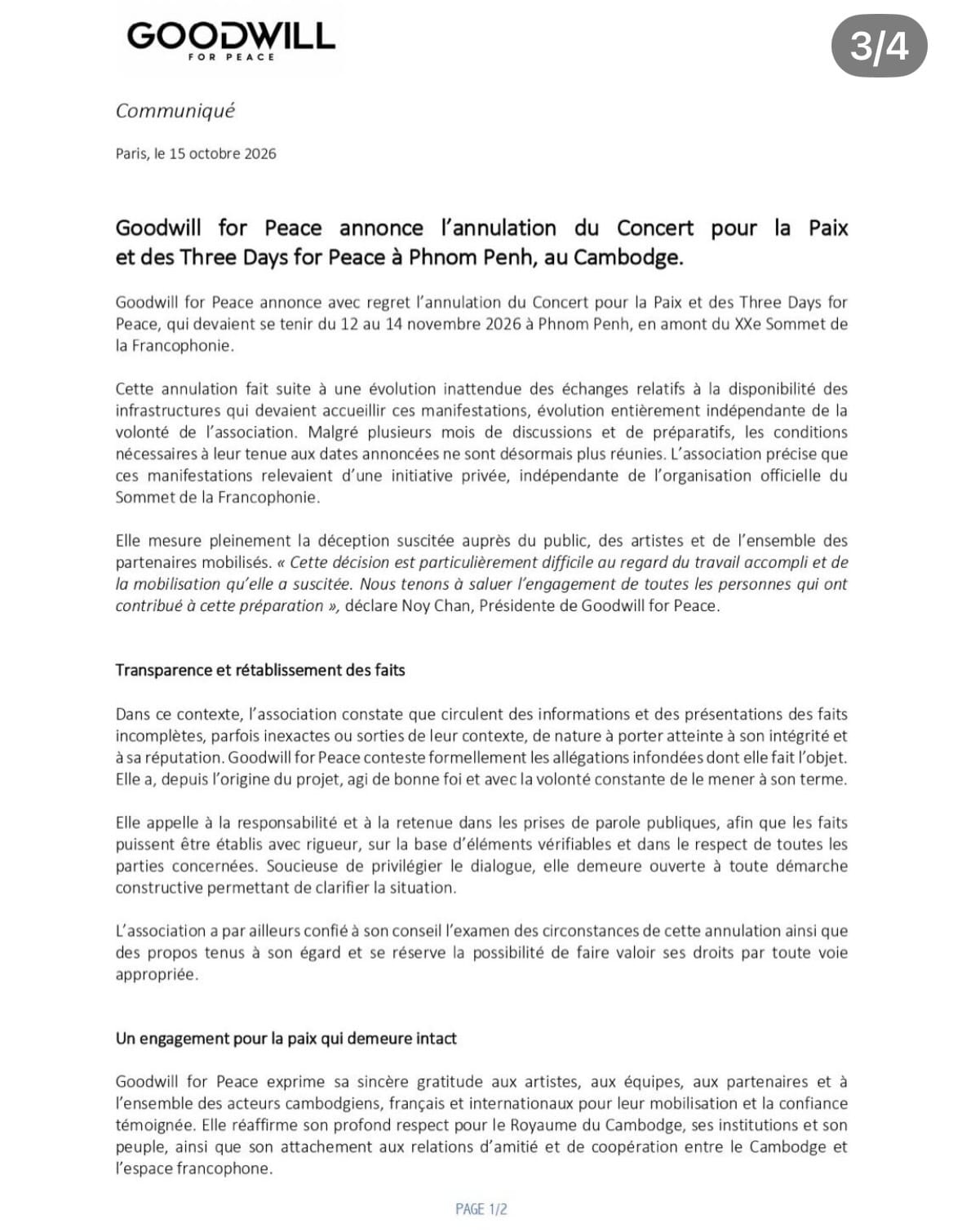
However, on October 15, 2026, Goodwill for Peace, chaired by Noy Chan, officially announced the cancellation of the Concert for Peace and Three Days for Peace, scheduled for November 12–14 in Phnom Penh. The association cited unexpected changes in venue availability, making it impossible to hold the events as planned despite months of preparation.
Communicating before funding is secured: a necessity, but also a responsibility
It would nevertheless be unfortunate if this situation discouraged ambitious cultural initiatives in Cambodia.
It is perfectly normal for project organizers to begin communicating before all the necessary resources have been secured.
An event of this scale cannot be built overnight. Seeking partners, sponsors and institutional support is often an integral part of the preparation process.
But this also comes with a responsibility: to clearly distinguish between an intention, an ongoing negotiation and a commitment that has already been confirmed.
This requirement becomes even more important when communications are directed at the general public and involve significant financial and logistical commitments, particularly when people may be considering travelling abroad for several days in order to attend an event.
The credibility of a major event is not measured only by the names it announces, but also by how clearly it communicates what it is genuinely in a position to deliver.
Riel Media remains available to receive any clarification or response from those responsible for the project.
Comments